

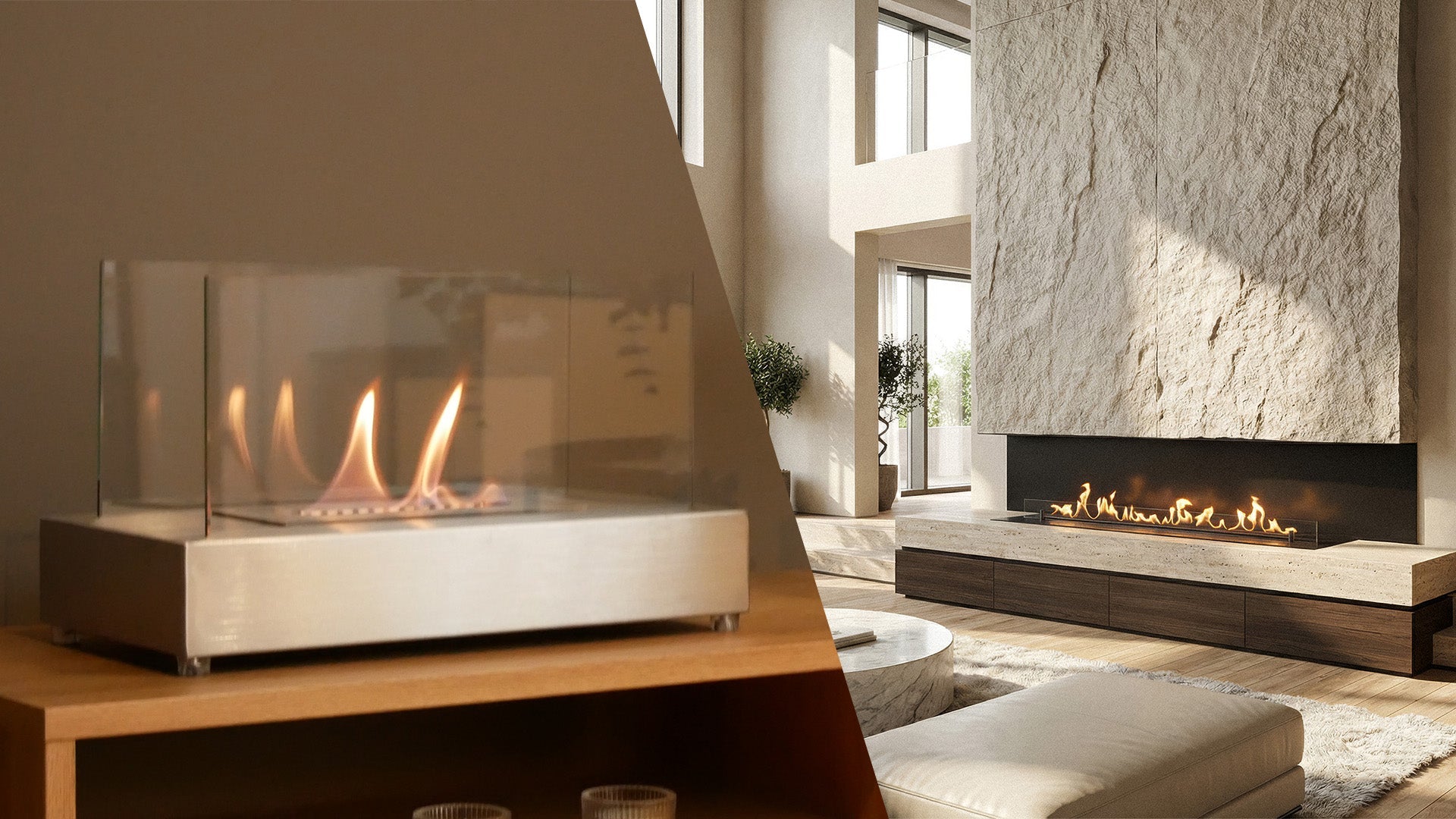
Before installing a bioethanol fireplace at home, it is important to consider the size of the room it will be used in. When a bioethanol fireplace burns, it produces carbon dioxide (CO2) — a molecule that is naturally present in the air, but which builds up when produced in larger quantities by combustion. If a fireplace is too large for the room it is placed in, CO2 levels can rise, which may cause headaches and discomfort.
The good news is that choosing the right sized fireplace for your room is straightforward, and we will walk you through exactly how to do it below.
How Much CO2 Does a Bioethanol Fire Produce?
To understand which fireplace is right for your room, it helps to know how much CO2 a bioethanol fire produces compared to other sources in the room. Here is a simple overview:
- Two people produce approximately 75 g of CO2 per hour
- A bioethanol fireplace burning 0.5 litres per hour produces approximately 740 g of CO2 per hour
- A room of 40 m² with a ceiling height of 2.5 metres has a volume of 100 m³
- Two adults consume approximately 55 g of oxygen per hour
- A bioethanol fireplace burning 0.5 litres per hour consumes approximately 800 g of oxygen per hour
As a general rule, in a room of approximately 80 m³, a bioethanol fireplace with a consumption of 0.5 litres per hour or less is recommended. It is also worth noting that beyond CO2, the only other by-products of burning bioethanol are heat and a small amount of water vapour — making it a very clean fuel source.
Finding the Right Fireplace for Your Room
The easiest way to find the right fireplace for your room is to use the chart below. First, calculate your room's volume in cubic metres (m³) by multiplying the floor area by the ceiling height. Then plot your fireplace's consumption per hour against your room size to see whether it falls within the recommended range.

X indicates the consumption of bioethanol fuel per hour. Y indicates the room size in cubic metres.
Ventilating the Room
One of the simplest ways to maintain good air quality whilst using a bioethanol fireplace is to ventilate the room. Opening a window slightly or leaving a door to an adjoining room ajar allows fresh air to circulate, helping to replace the oxygen consumed and dilute any CO2 produced. This is especially important if your room is on the smaller side or if you plan to use the fireplace for extended periods.


