

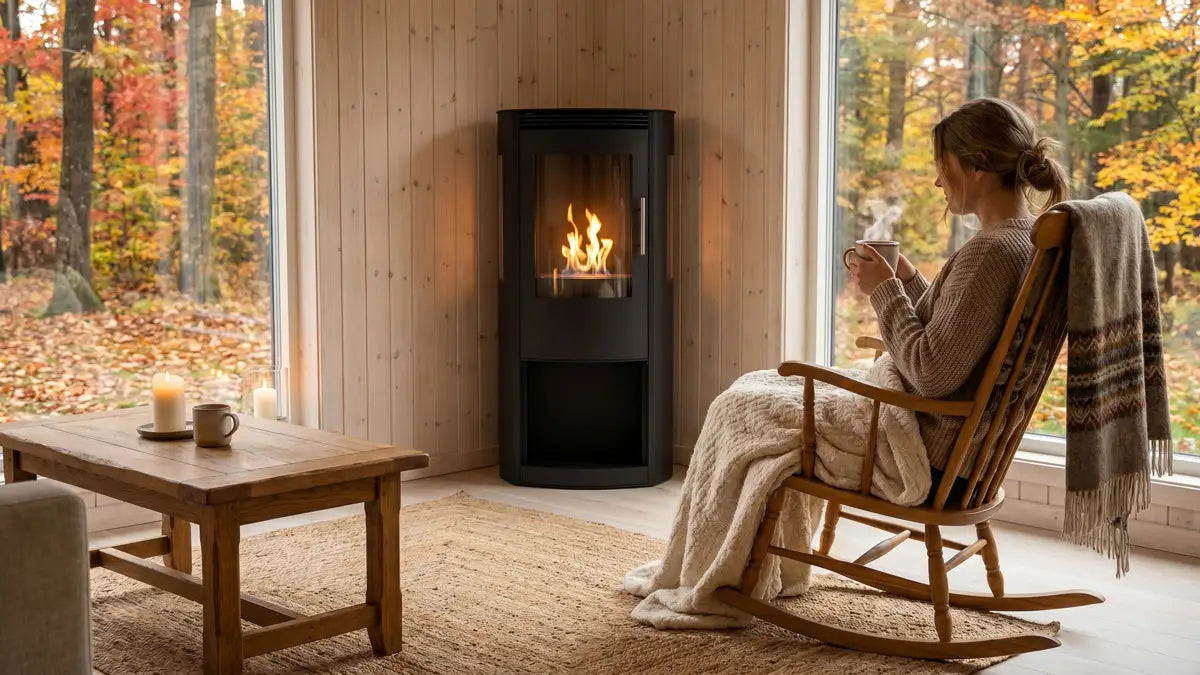
Due to inflation and rising energy prices, many homeowners are looking into alternative ways of heating their homes. A bioethanol fireplace can be used as a supplement to your existing heating system — heating a room relatively cheaply and in an eco-friendly manner. Bioethanol is produced from organic materials such as sugar beets, corn, and potatoes, making it a clean and sustainable fuel source. You can read more about bioethanol here.
Does a Bioethanol Fireplace Provide Heat?
Bioethanol fireplaces are a great way to add cosiness and warmth to your home. They create an inviting atmosphere and are great for entertaining and relaxing. But can a bio fireplace actually provide heat?
The short answer is yes — and let us elaborate a little further.
All bioethanol fireplaces give off heat, as the flame is created by real fire. Typically, bio fireplaces have a heat output of between 2–3 kW, which is roughly half of what a traditional wood-burning stove provides. Whilst this means they are not suitable as a primary heat source, they are perfectly capable of taking the edge off a cool evening or supplementing your central heating in autumn and spring when you don't need your heating on full.
Although it may be tempting to choose the bio fireplace with the highest heat output, it is important to consider the size of the room it will be placed in. A bio fireplace does not require a chimney or flue — instead it uses the oxygen in the room to burn. It is therefore important that the size of the fireplace is not too large relative to the size of the room where you plan to use it. The recommended room size is listed on all our products, but if you are still unsure, feel free to contact us.

Using a Bioethanol Fireplace as a Supplement to Your Heating System
A bioethanol fireplace works best as a supplementary heat source in the following situations:
- Autumn and spring: During the transitional seasons, your central heating may feel like too much, but the evenings can still be chilly. A bio fireplace is perfect for adding a few extra degrees of warmth without turning on the full heating system.
- Single rooms: If you spend most of your time in one room, a bio fireplace can heat that space efficiently without the need to heat the entire home.
- Rooms with poor insulation: A bio fireplace can help compensate for heat loss in rooms that are harder to keep warm.
- Reducing energy bills: By supplementing your central heating with a bio fireplace, you can lower your reliance on gas or electricity, potentially reducing your energy costs.
As a general rule, 1 kW of heat output is suitable for every 10 square metres of space. So for a room of 20 square metres, a bio fireplace with a heat output of around 2 kW would be ideal as a supplement.
Is a Bioethanol Fireplace Easy to Use?
There is a wide range of different bio fireplaces available on the market, so it can be difficult to know which one is right for you. The two main categories are manual and automatic (also known as remote-controlled).
Manual bio fireplaces are lit using a lighter, whilst automatic fireplaces are lit by pressing a button or using a remote control. In addition, automatic bio fireplaces feature built-in safety sensors that are not included in manual models.
Both types of bio fireplace are perfectly safe to use, as long as they are used correctly and in accordance with the manufacturer's instructions. Watch our guides below to see how each type works in practice:
How to Use a Manual Bioethanol Burner
How to Use an Automatic Bioethanol Burner
